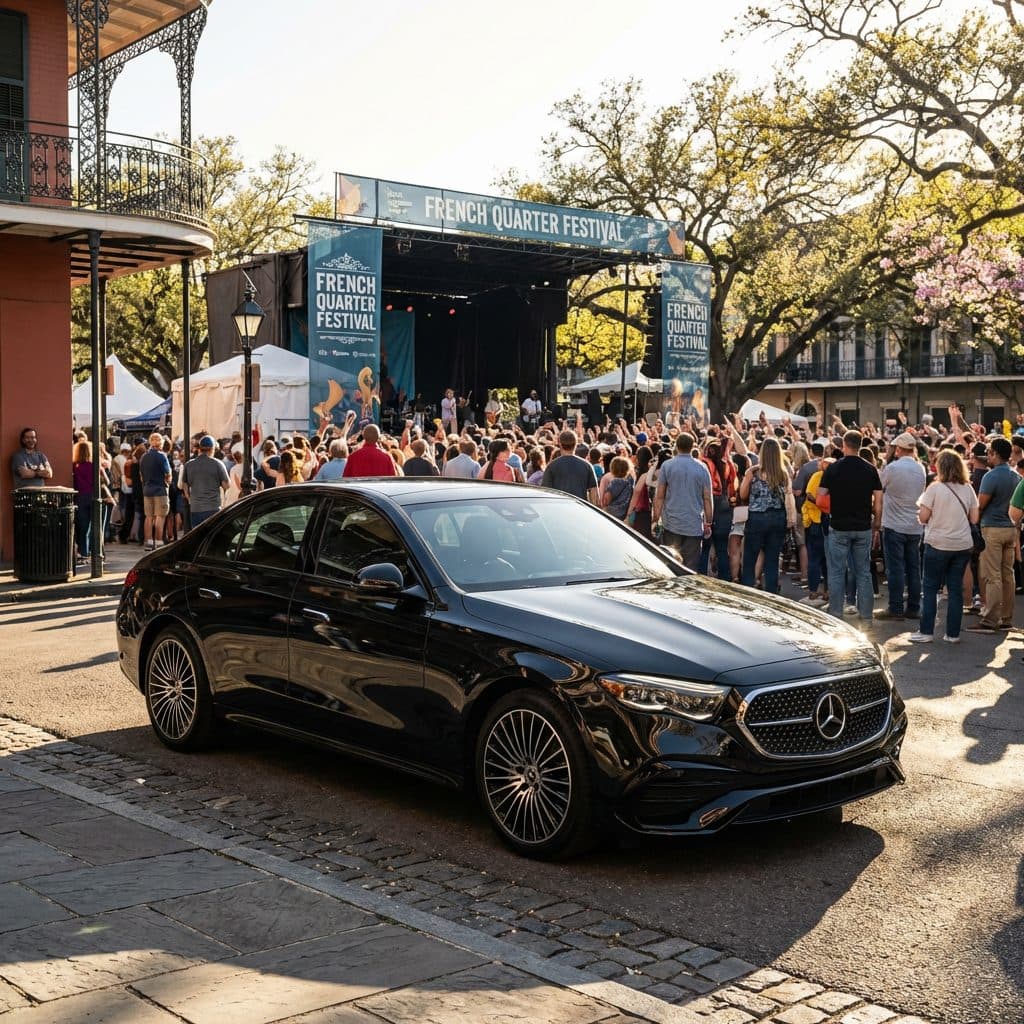
Short answer: French Quarter Fest 2027 runs Thursday, April 8 through Sunday, April 11, 2027, in the French Quarter and along the riverfront in New Orleans. It is free, there is no ticket, and the gates open at 11 AM each day. The festival describes itself as "the largest free music event in the United States," with more than 1,700 musicians across over 20 stages and food from more than 70 local restaurants (frenchquarterfest.org). None of that is what decides your day. What decides your day is that the festival closes a defined set of Quarter streets for four days, and where a vehicle can reach you depends entirely on that boundary.
French Quarter Fest 2027 dates and hours
| What | Detail |
|---|---|
| Festival dates | Thursday, April 8 – Sunday, April 11, 2027 |
| Days | 4 |
| Daily hours | 11:00 AM – 8:00 PM |
| Opening-day parade | Thursday, April 8, 10:00 AM — 200 block of Bourbon Street |
| Admission | Free; no ticket required |
| Location | French Quarter and Woldenberg Riverfront Park, New Orleans |
The 2027 dates appear as a banner across the festival's own site — "French Quarter Festival | April 8-11, 2027" (frenchquarterfest.org). The 2026 edition ran April 16 through 19.
One caution worth knowing before you book anything. The same site's FAQ page still prints the previous year's dates: "French Quarter Festival 2026 will take place Thursday, April 16, 2026, through Sunday, April 19, 2026" (frenchquarterfest.org). The FAQ prose lags the banner. When you check a date on a third-party listing in early 2027, verify it against the festival banner or the festival's own social channels, not against a FAQ answer that has not been rewritten.
Why the festival starts on a Thursday. The four-day shape is deliberate and it has been stable for years. Thursday is the softest day, Friday builds, and the two weekend days carry the weight. That single fact is the most useful scheduling tool a visitor has, because it means the same festival is two very different experiences depending on which day you pick.
Where the festival sits, and why the footprint decides everything
French Quarter Fest is not held on a fairground. It is held in a working neighborhood, using public streets and public parks as stages. The footprint runs from the riverfront at Woldenberg Park back through Jackson Square and the French Market, north along Royal and Bourbon Streets, and out to the New Orleans Jazz Museum on Esplanade Avenue.
That has one practical consequence that outweighs everything else in this guide: the Quarter operates as a venue with a perimeter for four straight days. The stages are inside the perimeter. The restaurants, hotels and homes are inside it too. So is the traffic.
For a visitor, the useful mental model is not "the festival is downtown." It is "the festival is a closed district with six published ways in, and my ride has to meet me outside or at an edge."
The stages: over 20 locations across the Quarter and the riverfront
The festival publishes its footprint as stage areas rather than a single map, and the count is "20+ stages throughout the French Quarter" (frenchquarterfest.org). The 2027 site banner adds that the programming covers "over 20 stages showcasing every genre of local music" (frenchquarterfest.org).
| Stage area | Character |
|---|---|
| Woldenberg Riverfront Park | The largest cluster, on the river; multiple stages and lawns |
| Jackson Square | The historic center of the footprint |
| The French Market | Under the market sheds, between Decatur and the river |
| Royal Street | Stages along the antique-district corridor |
| Bourbon Street | The Quarter's best-known street, stage set up within it |
| The JAX Lot | A parking lot turned venue, with its own festival gate |
| Spanish Plaza | Riverfront, next to the outlet center |
| New Orleans Jazz Museum | At the Old U.S. Mint on Esplanade Avenue |
Two things about that list matter more than the names.
The stages do not all open at once. The festival opens progressively: seven stages on Thursday, seven more on Friday, and the full footprint on Saturday and Sunday (frenchquarterfest.org). If you are coming on Thursday, you are coming to a smaller, easier festival than the one on Saturday.
The footprint is spread out, and the walk between stages is real. Woldenberg Park to the Jazz Museum on Esplanade is a little over a mile of Quarter streets. On a festival weekend with crowds, that is a 30 to 45 minute walk, not a five-minute stroll. People routinely underestimate this, and it is the single most common reason a group's plan falls apart in the middle of the afternoon.
A festival day, hour by hour
| Time | What happens |
|---|---|
| 10:00 AM Thursday | Opening parade steps off at the 200 block of Bourbon Street and ends in Jackson Square |
| 11:00 AM | Gates open and the day's stages begin |
| Early afternoon | The lightest crowds of the day; best window to move between stage areas |
| Late afternoon | Crowds build sharply, especially in Woldenberg Park and around Jackson Square |
| 7:00–8:00 PM | Closing sets; the heaviest foot traffic of the day at every gate |
| 8:00 PM | Festival grounds close |
The opener is a moving event, not a stage set: "begins at 10am on Thursday at the 200 Block of Bourbon and Bienville St." (frenchquarterfest.org). The city's public safety bulletin describes the parade route as Bourbon Street to St. Ann, right on St. Ann to Chartres, and right on Chartres into Jackson Square, with rolling closures along the way (nola.gov).
The 8 PM close is the number that should shape your evening. Every gate empties at once into a district whose streets are still closed to vehicles. If you are meeting a car, that is the busiest ten minutes of the entire day, and it happens at the same time at all six gates.
Free admission, and what you actually pay for
The festival is direct about this: "French Quarter Festival is free to attend!" and "Enjoy four days of live music with no admission cost" (frenchquarterfest.org). There is no ticket to buy and no wristband to collect at a gate.
What you pay for is everything behind the gate. Food, drinks and merchandise come from more than 70 festival booths "operated by some of New Orleans' finest restaurants open throughout the festival weekend" (frenchquarterfest.org). There are also Fest Family VIP packages, which the festival sells with the option to add parking.
One rule follows from the free admission and it catches visitors every year: outside food and drinks are not allowed on the grounds. The festival states the reason in the same breath — "To keep the festival free, outside food and drinks are not allowed" (frenchquarterfest.org). A cooler in the trunk is fine. A cooler at the gate is not.
There is a second rule with the same shape. The festival has been cashless in recent years, with a cash exchange available at the JAX Lot on Decatur Street, so bringing a card is the simpler plan.
Parking at French Quarter Fest 2027
The festival's own guidance is four words long: "Parking can be tricky, so arrive early" (frenchquarterfest.org). It is not being modest.
The lots the festival itself points to include the French Market, 300 North Peters Street, 211 Conti Street and The Garage at Canal Place (frenchquarterfest.org). What the festival does not offer is any reserved patron parking: "French Quarter Festival is a free, public event and does not have any reserved parking for patrons" (frenchquarterfest.org). Every space near the Quarter on a festival Saturday is a space someone else is also driving toward.
Two rules sit on top of that. All public parking areas are legally required to have accessible spaces (frenchquarterfest.org). And the city enforces a no-parking zone from Thursday at noon through Monday at 1 AM across a long list of Quarter streets — Barracks, Bienville, Canal, Chartres, Conti, Dauphine, Decatur, Elysian Fields, Esplanade, Iberville, Madison, North Front, North Peters, Orleans, Royal, St. Ann, St. Louis, St. Peter, St. Philip, Toulouse and Wilkinson Row. Vehicles in those zones may be ticketed, booted or towed, and the city deploys extra tow trucks for this event (nola.gov).
That combination — scarce supply, no reserved spaces, and a four-day tow zone — is why the parking question and the transportation question are the same question at this particular festival.
The streets that close, and how the closure zone works
This is the section to read twice, because these are the rules that decide whether a vehicle can reach you during French Quarter Fest 2027.
Four hard closures carry the event. Vehicle traffic is prohibited on Bourbon Street from Canal to Dumaine (a crossing may be allowed at St. Peter), Royal Street from Conti to St. Peter, Decatur Street from Conti to St. Peter, and North Peters Street from Conti to St. Louis (nola.gov).
Around those, there is a perimeter. The city applies exterior and interior closures across the area bounded by Canal Street to the north, Dumaine Street, Decatur Street on the river side and Rampart Street on the lake side (nola.gov).
Access past the checkpoints is restricted, not forbidden. Beyond the checkpoints, vehicle access is limited to residents, businesses and hotel guests. Residents and businesses collect access passes from the NOPD Eighth District station. If you are staying at a Quarter hotel, your hotel is your credential — ask the front desk what the property's arrangement is before the trip, not on the day.
Golf carts are prohibited inside the festival area (nola.gov). This is worth stating plainly because it is a class of vehicle some visitors assume is exempt.
The city's 2027 order does not exist yet. The rules above come from the City of New Orleans' public safety announcement for the 2026 festival, published April 13, 2026. The 2027 bulletin will not be published until the weeks before the event. The boundaries have been consistent for several years, which is why planning around them is reasonable — but confirm in the week of the festival, and treat any block-level detail here as the pattern rather than as a 2027 guarantee.
Where a car can meet you during French Quarter Fest 2027
The festival publishes six gates, and they are the most useful thing on its website for anyone arriving in a vehicle. Here they are as the festival lists them:
| Gate | Location |
|---|---|
| 2 Canal Street | Woldenberg Park |
| 300 Bienville | at Front Street, Woldenberg Park |
| 600 block of Decatur | at Toulouse Street, JAX Brewery Lot |
| 800 block of Decatur | Jackson Square |
| 400 block of Esplanade | New Orleans Jazz Museum |
| 1300 North Peters Street | Governor Nicholls Wharf |
The festival recommends these gates for visitors using mobility devices, noting they "offer the most accessibility," and it posts signage with a wheelchair symbol pointing to curb cuts (frenchquarterfest.org).
The gates are also, for a different reason, the right places to meet a vehicle. Each one sits at or near the edge of the closure perimeter. The Canal Street and Esplanade Avenue sides stay open to traffic, and the city's own guidance to attendees is to use rideshare drop-off along Canal Street or Esplanade Avenue (nola.gov).
In practice, a meeting point that works on a festival day has four properties:
- It is outside the perimeter, at a gate or on Canal or Esplanade. A car cannot come to you inside the closure zone unless you are a hotel guest and the vehicle is on the permitted list. Meet it at the edge.
- It is a named address, not a description. "Near the festival" is not a location. "1300 North Peters" is.
- It is on the side of the Quarter you are actually heading to. Crossing the district on foot is easy and often pleasant. Crossing it in a vehicle during festival hours is not possible.
- It is set for a time you chose, not a time you hoped for. The 8 PM close concentrates everyone at every gate simultaneously.
Your walking distance is the one variable you fully control, and at this festival it is worth more than usual: two blocks of walking at the start of an evening routinely saves twenty minutes of waiting at the end of it.
Hotel-zone timing: when to leave and when to come back
The most useful number in a French Quarter Fest plan is the one you set yourself — what time the vehicle leaves.
Work backwards from the gate, not from the mileage. On a normal weekday these runs are short. During festival hours they are longer, and the reason is always the same: the last quarter mile is inside a perimeter that has been closed since Thursday at noon.
| You are staying in | Leave before your target time | Why |
|---|---|---|
| French Quarter or CBD hotel | 45–60 minutes | You are inside the perimeter; the vehicle meets you at a gate, not the door |
| Warehouse District or Convention Center | 30–45 minutes | Outside the closure, but the inbound streets carry the festival traffic |
| Garden District or Uptown | 45 minutes | Short run, made variable by cross-town traffic |
| Metairie, Kenner, airport corridor | 60–75 minutes | I-10 backs up on festival weekends; parking is the reason most people drive |
| North Shore | 90 minutes | The Causeway is the longest inbound leg on the board |
Mornings are easy and evenings are hard. The gates open at 11 AM and the grounds close at 8 PM. A departure before noon encounters a normal city. A departure at 7 PM encounters a district that is emptying through six gates at once.
Sunday is the lightest day and the busiest departure. Sunday afternoon foot traffic is the softest of the four days, and Sunday evening is when the largest number of visitors are simultaneously heading to the airport. If your flight is Sunday evening, treat the airport run as a festival-hour run, not as a normal one.
Flying in: MSY to the French Quarter during French Quarter Fest 2027
Louis Armstrong New Orleans International Airport is at 1 Terminal Drive in Kenner, roughly 20 to 30 minutes from the French Quarter outside peak hours (frenchquarterfest.org).
The airport end of the trip is the predictable part, and the airport publishes exactly how its ground transportation works. For ride-app users there is a dedicated pickup spot: "Level 1 outside Baggage Claim between doors 9 and 11" (frenchquarterfest.org). That detail is worth knowing before you land, because at a festival-week arrival the terminal curb is not the place to be figuring it out.
The downtown end is where the festival changes things. An MSY-to-hotel run that takes 25 minutes on a Tuesday can take considerably longer on the Friday or Saturday of festival weekend, and the final approach to a Quarter hotel may end at a perimeter checkpoint rather than at the front door.
The practical consequence is a timing rule: on arrival, budget the airport run as if it were a peak-hour run, and on departure, book the return leg before you need it. A Sunday evening departure competing with a festival weekend's outbound traffic is not the moment to be ordering a car.
If you are arriving by air and heading straight to a hotel, the airport side of the trip is handled on our New Orleans airport transportation page.
Streetcar, ferry, RTA and Blue Bikes
Not every leg needs a car, and the festival's own travel page is useful on this. It lists the streetcar routes that reach the Quarter — #11 Magazine, #12 St. Charles, #47 Canal/Cemeteries, #48 Canal/City Park, and #49 Riverfront/UPT, noting that "the Riverfront/UPT line has stops near parking lots and the festival" (frenchquarterfest.org).
There is also a ferry. "A passenger-only ferry boat runs from Algiers Point to the RTA Ferry Terminal at the foot of Canal St." (frenchquarterfest.org) — and that terminal sits beside a festival entrance, which makes the ferry one of the cleanest approaches to the grounds for anyone staying on the West Bank.
The city adds capacity on that route during the festival, and it publishes a single place to check live service: riders are directed to the Le Pass app, norta.com, or Rideline at (504) 248-3900 for updates and trip planning (nola.gov). On a festival weekend a streetcar line can be rerouted with little warning, so checking that number before you leave the hotel is worth the thirty seconds.
The festival also promotes Blue Bikes, the local nonprofit bikeshare, and asks riders to drop bikes at stations surrounding the Quarter rather than bringing them inside (frenchquarterfest.org).
Transit is a genuinely good answer for the middle of a festival day. It is a poor answer for a group of six with dinner reservations across town, and it stops being an answer at all after the last set.
Getting your group there, at any size
Group size is not the constraint. Jazzy Limousine & Shuttle runs sedans and SUVs for couples and small families, Executive Sprinters for mid-size parties, Executive Buses, and full motorcoaches — so a party of four and a party of forty are each a single booking, with one contact and one manifest.
French Quarter Fest is where that matters, for three reasons specific to this event.
The perimeter is the problem, and it multiplies by the number of vehicles. Five separate ride-share requests at 8 PM are five drivers each making their own judgement about a boundary that is actively enforced. One vehicle with one named meeting point removes that entire class of problem.
The walk between stages is the real cost, and it is shared. A group that arrives together can decide together whether the next set is worth a 40-minute walk. A group that arrives in five cars tends to discover it has already split up.
The parking rules do not apply to a vehicle that is never parked. A chauffeured vehicle that drops and collects is not hunting for a space in a district with no reserved patron parking and a four-day tow zone.
If your group is large enough to travel by motorcoach, tell us early. April motorcoach capacity in New Orleans is committed well before the festival, and a large vehicle's staging plan has to be designed around the perimeter rather than improvised at a gate.
Planning notes
Choose your day deliberately. Thursday and Friday are materially calmer than Saturday and Sunday. If the trip is flexible, the weekday is the better festival.
Plan to walk, and plan for more of it than you think. The footprint runs from Woldenberg Park to the Jazz Museum. Comfortable shoes are not a cliché at this event; they are the difference between seeing four stages and seeing two.
Pick one gate and use it all weekend. Six gates with six different approaches is six plans. One gate near your hotel, learned on Thursday, is a plan that works by Sunday.
Keep the evening simple. The grounds close at 8 PM and everyone leaves at once. A vehicle already waiting at a gate you have used all weekend beats a vehicle summoned at 7:55.
Check the city's bulletin in the week of the festival. The 2027 closure order will be published shortly before the event and is the authoritative word on street boundaries. Everything in this guide about closures describes the pattern, not the 2027 order itself.
Ask your hotel about the access arrangement. Quarter hotels sit inside a restricted zone where vehicle access is limited to residents, businesses and hotel guests. Front desks know their own property's arrangement. Getting that answer in advance removes the one variable a visitor cannot solve alone.
Booking French Quarter Fest 2027
French Quarter Fest is one of the largest events on the New Orleans calendar, and it is the one where the transportation question is genuinely structural rather than a matter of preference. The streets close. The parking is not there. The gates are the only way in.
Three things worth saying plainly.
First, book the meeting point, not just the time. On a festival day, the address matters more than the hour. A vehicle at the right gate ten minutes late is a working plan. A vehicle on time at the wrong side of the perimeter is not.
Second, book the outbound and return as one movement. Two separate bookings on a festival evening means two drivers, two meeting points and nobody who owns the evening — and on a night when six gates empty at 8 PM, that gap is the difference between a plan and a scramble.
Third, if you are flying in, the airport leg and the festival leg are separate runs and should be booked as such, so that one vehicle meets the flight and another meets you on the day you are going out to hear music.
That work sits on our French Quarter Fest transportation page, and the Quarter-specific side of it on our French Quarter limo service page. If the trip runs past the festival — and in April it usually does — the cruise terminal and hotel side is handled on our hotel and cruise port transfers page.
Tell us the day, the gate you want to use, the hotel zone and the headcount, and the day arranges itself around three fixed points: a departure that beats the crowd, a named meeting point outside the perimeter, and a vehicle already waiting when the last set ends.
Frequently Asked Questions
When is French Quarter Fest 2027?
French Quarter Fest 2027 runs Thursday, April 8 through Sunday, April 11, 2027, in the French Quarter and along the riverfront in New Orleans. Gates open at 11 AM each day and close at 8 PM. The 2026 edition ran April 16 through 19, so the festival moves earlier in April by about a week each year depending on how the city calendar falls.
How many stages and performers does French Quarter Fest 2027 have?
The festival's own description is 1,700-plus musicians on more than 20 stages, with an extensive culinary lineup of over 70 food and beverage booths run by local restaurants. It does not open all of them at once: seven stages run on Thursday, seven more open on Friday, and the full footprint is live on Saturday and Sunday. Stage areas include Woldenberg Riverfront Park, Jackson Square, the French Market, Royal Street, Bourbon Street, the JAX Lot, Spanish Plaza and the New Orleans Jazz Museum.
Is French Quarter Fest 2027 free to attend?
Yes. The festival states plainly that it is free to attend and that there is no admission cost, and there is no ticket to buy in advance. You pay for food, drinks, merchandise and any Fest Family VIP package you choose. To keep admission free, outside food and drinks are not permitted on the festival grounds, so plan to eat and drink from the booths.
Which streets close for French Quarter Fest 2027?
The City of New Orleans closes Bourbon Street from Canal to Dumaine, Royal Street from Conti to St. Peter, Decatur Street from Conti to St. Peter, and North Peters Street from Conti to St. Louis, with exterior and interior closures across the area bounded by Canal Street, Dumaine Street, Decatur Street and Rampart Street. Vehicle access past the checkpoints is limited to residents, businesses and hotel guests. The city's 2027 order is not published yet; the list above is the pattern the last several years have used.
Where are the French Quarter Fest 2027 entrance gates?
The festival publishes six gates: 2 Canal Street at Woldenberg Park, 300 Bienville at Front Street, the 600 block of Decatur at Toulouse, the 800 block of Decatur at Jackson Square, the 400 block of Esplanade at the New Orleans Jazz Museum, and 1300 North Peters Street at Governor Nicholls Wharf. The festival recommends these gates for anyone using a mobility device because they offer the most accessible approach.