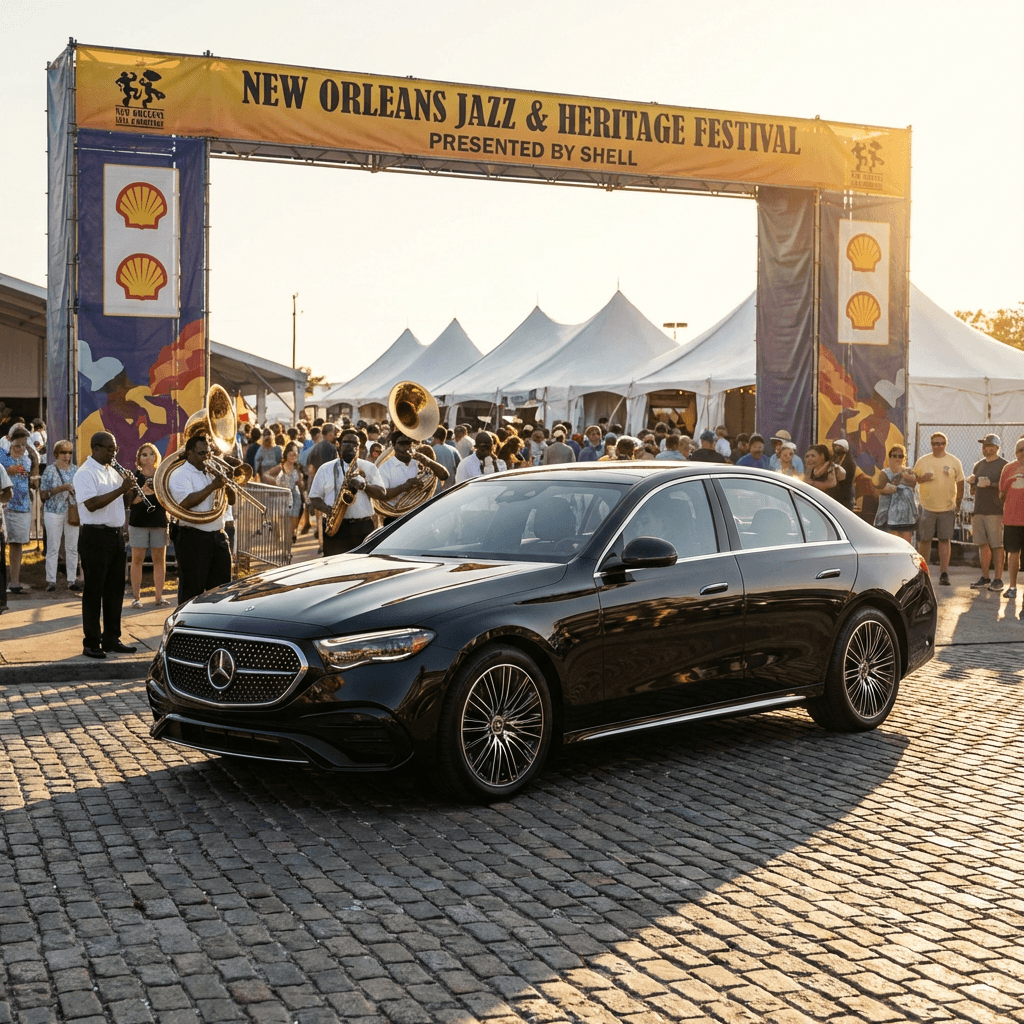
Short answer: Jazz Fest 2027 runs Thursday, April 22 through Sunday, April 25 and Thursday, April 29 through Sunday, May 2, all of it at the Fair Grounds Race Course, 1751 Gentilly Boulevard. That is eight festival days. Gates open at 11 a.m. and the grounds close at 7 p.m., with the last admission at 6:30 p.m. Two facts decide how you plan around it: the streets near the Fair Grounds close on a published schedule every one of those days, and rideshare vehicles are excluded from the perimeter around the venue entirely.
This guide covers the dates weekend by weekend, where the gates are, what happens to parking and the surrounding streets, when to leave from a hotel, and what the options are for a group of any size.
Jazz Fest 2027 dates, weekend by weekend
The New Orleans Jazz & Heritage Festival presented by Shell returns in 2027 across two four-day weekends, both of them running Thursday through Sunday.
| Weekend | Days | Dates |
|---|---|---|
| Weekend One | Thursday – Sunday | April 22 – 25, 2027 |
| Weekend Two | Thursday – Sunday | April 29 – May 2, 2027 |
The festival states the range itself: "They are Thursday, April 22 – Sunday, April 25 & Thursday, April 29 – Sunday, May 2, 2027" (nojazzfest.com). New Orleans & Company, the city's convention and visitors bureau, publishes the same two weekends: "Jazz Fest will return in 2027 from Thursday to Sunday on the weekends of April 22-25 and April 29 - May 2, 2027" (neworleans.com).
Eight festival days, and the "10-day" line is legacy copy. The official FAQ also introduces the event as a "10-day cultural feast." The dates it publishes in the same document span eight festival days, and the City of New Orleans counts them the same way — the Jazz Fest Express "operates all eight days of the festival" (ready.nola.gov). Plan for eight. If a hotel, a tour or a booking form describes Jazz Fest 2027 as a ten-day event, it is working from the older phrasing.
Why the dates matter more than they look. Both weekends open on a Thursday, which means the two quietest days of each weekend are the two most useful — smaller crowds, easier movement in and out, and far more flexibility on when a vehicle can reach a gate. If your schedule allows only one day, a Thursday is a materially easier day than a Saturday.
Where the festival sits, and why that shape decides everything
Jazz Fest is held at the Fair Grounds Race Course, a working racetrack in the Gentilly neighborhood. The festival describes it as "centrally located at 1751 Gentilly Boulevard, 10 minutes from the French Quarter" (nojazzfest.com).
That "10 minutes" is a normal-day figure and it is worth holding onto as exactly that. The Fair Grounds sits in a residential grid, not on a highway interchange, and the streets feeding it are two-lane. When 400,000 people arrive across eight days — the festival's own attendance figure — the same ten-minute drive becomes something quite different, and the closing window each evening is slower still.
The City of New Orleans names the neighborhoods that absorb the impact directly: "Fairgrounds, Bayou St. John, Desaix, and Seventh Ward" (ready.nola.gov). If you are staying anywhere in that ring, you live inside the traffic plan rather than driving into it, which changes the math in your favor.
Gate times and the shape of a festival day
The Jazz Fest 2027 hours are fixed and they do not flex:
| What | Time |
|---|---|
| Gates open | 11:00 a.m. daily |
| Last admission | 6:30 p.m. |
| Grounds close | 7:00 p.m. |
The festival states it plainly: "Hours are 11 a.m. – 7 p.m. (The last admission to the Festival is 6:30 p.m.)" (nojazzfest.com).
The 6:30 p.m. cutoff is the one that catches people out. It is a hard stop on entry, not a soft one, and it arrives while the day is still in full swing. Anyone planning to join a group late in the afternoon should aim to be through a gate by 6:00 p.m. rather than treating 7 p.m. as the deadline.
The end of the day is the real bottleneck. Seven o'clock empties the Fair Grounds at once, and the evening street closures exist precisely because of it. Every option — the official express, a taxi from a designated stand, a private vehicle, a hotel shuttle — is competing for the same few open corridors at the same moment. This is the single most useful thing to understand about a Jazz Fest 2027 day: the trip in is manageable, and the trip out is the part that needs a plan.
Getting in: the three gates, and why rideshare cannot reach the door
There are three public gates, and knowing which one you are aiming for matters more than it sounds:
- Gentilly Boulevard — the main entrance, and where the accessible-parking spaces and the designated taxi stand sit.
- Sauvage Street — the second main gate, with day-of ticket sales nearby.
- Trafalgar Street — the third public gate.
The festival confirms all three as entry and exit points: patrons may "enter and exit at any of the three public gates: Gentilly Blvd., Trafalgar Street and Sauvage Street" (nojazzfest.com).
Now the part that surprises first-time visitors.
Rideshare is excluded from the Jazz Fest 2027 venue perimeter. The festival's own FAQ says "the City excludes rideshares from dropping off or picking up passengers within a certain perimeter around the venue" (nojazzfest.com). This is not a suggestion or a surge-pricing problem — it is a rule. An Uber or Lyft cannot take you to a gate, and it cannot collect you from one.
Instead, both companies are required to send riders to fixed hail points. For Uber, the City lists N. Carrollton & Esplanade, N. Broad & St. Bernard, N. Broad & Ursulines, and Gentilly Blvd. & Paris. For Lyft, the same four intersections plus Deutsches Haus at 1700 Moss Street (ready.nola.gov).
The practical effect is a walk at both ends of the day, in the heat, at the moment when the fewest drivers are available. New Orleans & Company's guidance is blunt about the second half of that: "Because of the high volume of ride-share requests, it may make sense to walk a few blocks past the perimeter" (neworleans.com).
Taxis work differently, and better. Cabs are permitted to use designated stands rather than being pushed to the perimeter. The City's rule is that "Taxis are only permitted to drop off and pick up fares at designated taxi stands" (ready.nola.gov), and the two stands are at Fortier Park on Esplanade Avenue and Stallings Playground on Gentilly Boulevard — the latter directly across from the festival entrance (nojazzfest.com). A pedicab stand sits beside the Mystery Street stand.
Bicycles are genuinely good here, with one catch. The festival provides "limited parking for bicycles... free of charge" near the Gentilly Boulevard and Sauvage Street pedestrian gates, and the City notes Blue Bikes drop zones at the same two entrances. Bikes are not allowed on the festival grounds themselves, and the festival asks that you "do not lock bikes on Fair Grounds fences or private fences" (nojazzfest.com, ready.nola.gov).
Parking at and around the Fair Grounds
This is the shortest section in the guide, because the honest answer is that parking is not a plan for most people.
| Option | Reality |
|---|---|
| On-site parking | Pre-purchase only, bundled with Big Chief, Grand Marshal and Krewe of Jazz Fest VIP packages |
| Accessible parking | Limited spaces sold at the Horseman's Gate on Gentilly Blvd., first-come, first-served |
| Neighborhood street parking | Restricted to residents only |
| Oversized vehicles (RVs, charter buses) | No on-site parking or unloading at all |
| Off-site lots and hotel shuttles | Variable; many downtown hotels run their own |
The festival is direct about all of it: "There is very limited parking on-site at the Fair Grounds," and "Parking on-site is ONLY available for pre-purchase with the Big Chief, Grand Marshal and Krewe of Jazz Fest VIP packages." Then the line that rules out the obvious workaround: "Note: Parking in the surrounding neighborhood is restricted to residents only" (nojazzfest.com).
The restricted access area is what enforces that. It runs from 9:00 a.m. to 9:00 p.m. on festival days, bounded by Mystery Street, Fortin Street, Gentilly Boulevard and Grand Rte. St. John Street. Inside those boundaries, "Vehicles without residential permits will not be allowed" (ready.nola.gov). That is a permit checkpoint, not a parking restriction, and it means the residential streets closest to the gates are closed to you by rule rather than by luck.
Parking enforcement around Jazz Fest 2027 is active and towing is real. The City's own list of what will get you ticketed is worth reading once: do not block hydrants, driveways or sidewalks; do not park within 20 feet of a crosswalk, intersection or stop sign; and park in the direction of travel on one-way streets, right wheel to the curb on two-way streets. Parking enforcement can be reached at 504-658-8100 (ready.nola.gov).
The streets that close around the Fair Grounds and Bayou St. John
Two separate Jazz Fest 2027 closure mechanisms run at the same time, and they behave differently.
1. The restricted access area, all day. A permit-controlled zone, 9:00 a.m. to 9:00 p.m. on festival days, bounded by Mystery Street, Fortin Street, Gentilly Boulevard and Grand Rte. St. John Street. Vehicles without residential permits are not allowed in (ready.nola.gov).
2. The evening exit closures, each night. These exist to move the crowd out safely, and they cut two of the main corridors between the Fair Grounds and the rest of the city:
| Corridor | Closed from | Closed to |
|---|---|---|
| Esplanade Avenue | Broad Street | Moss Street |
| Gentilly Boulevard | St. Bernard Avenue | Bayou Road |
The City describes them as "temporary street closures... to facilitate the safe exit of Jazz Fest goers each evening" (ready.nola.gov). Read the two together and the picture is clear: the Esplanade closure is the Bayou St. John and Mid-City side, and the Gentilly closure is the Seventh Ward side. Between them they take out the two most natural routes away from the venue at exactly the hour everyone is leaving.
And they can expand. The City warns that "additional intermittent street closures might be required as crowd size warrants" (ready.nola.gov). On a sold-out Saturday the plan on paper and the plan on the ground are not always the same plan.
One caveat that matters. The closure detail above is drawn from the City's and NOPD's published guidance for the most recent Jazz Fest. The department reissues the order each year, and the 2027 order is not out yet — it typically lands in the weeks before opening. Treat the pattern as reliable and the exact boundaries as provisional, and re-check before you travel. If you are planning in advance, the closure map to watch is on the City's Jazz Fest page (ready.nola.gov).
Hotel-zone timing: when to leave, and when to come back
Where you stay for Jazz Fest 2027 changes the shape of the day more than any other decision.
French Quarter and CBD. The closest hotels to the Fair Grounds by the straightest route, and the ones the festival measures from — "10 minutes from the French Quarter" (nojazzfest.com). In practice this is the zone where the difference between a 10:00 a.m. departure and a 12:00 p.m. departure is enormous: the first arrives before the gates open, the second arrives into the full weight of the inbound traffic.
Warehouse District and South Market District. Slightly further out, but well positioned for the official express, which picks up at the Sheraton on Canal and the Hyatt Regency on Loyola (nojazzfest.com).
Garden District, Uptown and Mid-City. Here the evening closures matter most. A Mid-City hotel sits on the wrong side of the Esplanade closure at the end of the night, and the route that looks shortest on a map is very often the closed one.
Working timings for a festival day:
- Leave 90 minutes before you want to be inside. Gates at 11 a.m. means leaving around 9:30 a.m., which clears the restricted access area as it comes into force and gets you in before the crush.
- Plan the return for after 8:00 p.m., not 7:00 p.m. The grounds close at 7 p.m. and the exits are thickest for the next 45 to 60 minutes.
- If you are meeting a vehicle, name a point outside the perimeter. Every option that can reach a gate is contested at closing; every option that cannot is quick and predictable one or two blocks out.
Our chauffeurs work this event every year and the pattern does not change: the morning is easy, and the evening is a queue. That is why the return leg is the one worth booking in advance rather than improvising.
The official Jazz Fest Express
The festival runs its own express service, and it has one advantage nothing else has: it is "the only shuttle that drops-off and picks-up patrons inside the gates of the Festival" (nojazzfest.com).
| Detail | Value |
|---|---|
| Runs | All eight festival days |
| Hours | 10:30 a.m. – 7:30 p.m. |
| Departure points | Four |
| Tickets | Sold day-of at departure points |
| Information | (504) 569-1401 |
New Orleans & Company calls it "the easiest and most convenient option" for the same reason — it is "the only one that drops passengers directly inside the Fair Grounds gates" (neworleans.com).
The four departure points, as the festival lists them (nojazzfest.com):
- French Quarter — Steamboat Natchez Dock, 400 Toulouse Street at the river
- Downtown — Sheraton New Orleans Hotel, 500 Canal Street
- South Market District — Hyatt Regency, 601 Loyola Avenue
- City Park — Wisner Lot, 5700 Wisner Boulevard near Filmore Avenue, with parking included
A one-way pass is available at the Fair Grounds when you are leaving. Service runs "10:30 a.m.–7:30 p.m. daily" per New Orleans & Company, and the festival notes it runs until all patrons have left the grounds (neworleans.com, nojazzfest.com).
Worth knowing before you rely on it. The express departs on a schedule from fixed points, so it works best for someone staying within walking distance of one of the four. It also puts you in a vehicle with everyone else on that run, and the return leg is a wait rather than a departure on demand. For two people on a single day, that trade is often worth taking. For a group on a schedule, or anyone staying outside those four zones, it is usually the wrong tool.
Streetcar, bus and RTA
The Regional Transit Authority runs its normal network through the festival, with the caveat that the crowds affect it: "RTA routes may experience delays or detours during the event" (ready.nola.gov).
New Orleans & Company points to the Jackson-Esplanade Bus (91), which "drops off only a few blocks from the entrance," and notes that a three-day RTA pass can be had for about $9 (neworleans.com). Service alerts are posted through the RTA GoMobile app and at norta.com, and the Ride Line is 504-248-3900 (ready.nola.gov).
For a single rider going a short distance, this is the cheapest option on the page and worth taking seriously. It is also the option most exposed to the crowd, because a bus in a closed corridor is just a bus in a closed corridor.
Arriving from the airport
Most out-of-town Jazz Fest 2027 trips start at Louis Armstrong New Orleans International Airport, and the airport leg is usually the simple half of the week — MSY sits well outside every closure zone, and the airport operates around the clock.
The complication is at the other end. A flight that lands at 6 p.m. on a festival Friday drops you into the same evening traffic plan as everyone leaving the Fair Grounds, and your hotel may sit inside or adjacent to the restricted access area. Booking the airport transfer with the festival dates attached, rather than as a separate one-off, means the driver already knows what is closed that day. Details are on our New Orleans airport transportation page.
Groups of any size
A festival is usually a group trip, and this is the part where most transportation plans fall apart — not because the vehicles do not exist, but because a provider quotes for four and then discovers the booking is for forty.
Group size is never the constraint for Jazz Fest 2027. The fleet runs from sedans and SUVs through Sprinters, executive buses and motorcoaches, and when a single vehicle will not hold everyone, we dispatch more than one and keep them together on the same schedule. What changes with size is not whether it can be done, but how early it needs to be booked — the multi-vehicle days around Jazz Fest are the first to go.
Bands and crew, wedding parties in town around the festival, corporate groups, family reunions and conference attendees all run on the same calendar, so the practical advice is the same for every one of them: tell us the real number up front, including the people who have not confirmed yet, and lock the festival dates early.
What the Fair Grounds fee is, and how festival pricing works
There is one cost specific to this event that is worth understanding before you compare quotes, because it is not a surcharge anyone invented — it is a fee the festival's traffic plan imposes on vehicles entering the venue area.
For Jazz Fest, that Jazz Fest Traffic Fee is $75 per vehicle, each way, for sedans and SUVs, and it rises with vehicle size. It is included in the all-in rate rather than added at the end, which is why a Jazz Fest quote and a quote for the same distance on an ordinary Tuesday are not the same number.
Festival dates also carry event pricing, and the current all-in figures — by vehicle type, along with the options available across both weekends — live on the Jazz Fest service page rather than in this article, which will still be here in May and the rates will not. What does not change is the shape of it: a flat rate per vehicle, each way, quoted and locked when you book.
If your trip is built around a hotel, and you want the airport run and the festival runs handled as one booking, the hotel and cruise port transfer page covers that side of it.
Planning notes
- Book the return before you need it. The outbound trip is predictable; the 7 p.m. exit is the one where improvisation costs an hour.
- Name a meeting point, not a gate. Only taxis and the official express are permitted at the gates themselves.
- Build in the walk. If you are using rideshare, both ends of the day include one.
- Re-check the closures the week you travel. The 2027 NOPD order is not published yet; the pattern in this guide is.
- Thursday is the easy day. If you have one day to choose, choose that one.
Frequently asked questions
The questions above cover the ground most people need. For anything specific to your dates, group or route, the Jazz Fest service page has the current options, or call and we will work through the plan with you.
Frequently Asked Questions
When is Jazz Fest 2027?
Jazz Fest 2027 runs Thursday, April 22 through Sunday, April 25, and Thursday, April 29 through Sunday, May 2. That is two four-day weekends and eight festival days in total, all at the Fair Grounds Race Course, 1751 Gentilly Boulevard. The dates come from the festival's own FAQ, which states them as "Thursday, April 22 – Sunday, April 25 & Thursday, April 29 – Sunday, May 2, 2027."
What time do the gates open at Jazz Fest 2027?
Gates open at 11 a.m. every festival day and the grounds close at 7 p.m. The last admission is at 6:30 p.m., which is the number that catches people out — arriving at 6:45 p.m. means being turned away. There are three public gates for entry and exit: Gentilly Boulevard, Trafalgar Street and Sauvage Street.
Can you park at the Fair Grounds during Jazz Fest 2027?
Almost never. The festival states that on-site parking is "ONLY available for pre-purchase with the Big Chief, Grand Marshal and Krewe of Jazz Fest VIP packages," and that parking in the surrounding neighborhood is restricted to residents only. A limited number of accessible spaces are sold at the Horseman's Gate on Gentilly Boulevard on a first-come, first-served basis. There is no on-site parking or unloading at all for oversized vehicles such as RVs and charter buses.
Which streets close around the Fair Grounds and Bayou St. John during Jazz Fest 2027?
Two separate things happen. A restricted access area runs from 9 a.m. to 9 p.m. on festival days, bounded by Mystery Street, Fortin Street, Gentilly Boulevard and Grand Rte. St. John Street, and vehicles without residential permits are not allowed inside it. Then, each evening, temporary closures are made to let the crowd out safely: Esplanade Avenue from Broad to Moss, and Gentilly Boulevard from St. Bernard Avenue to Bayou Road. The city also warns that additional intermittent closures can be added as crowd size warrants.
Can a group of any size ride together to Jazz Fest 2027?
Group size is never the constraint. A party of two and a party of two hundred are the same conversation, booked the same way — sedans and SUVs for small groups, then Sprinters, executive buses and motorcoaches, with more than one vehicle dispatched together whenever a single one will not hold everyone. Bands, wedding parties, corporate groups and family reunions all run on the same calendar, so the earlier you lock the dates the more choice you have.